Welcome to Every Three PM

Tag: KoreanCulture

  • Just a ‘Dog Dream’? Why Tigers Rule the Korean Dream World

    Just a ‘Dog Dream’? Why Tigers Rule the Korean Dream World

    Yesterday, I had the weirdest dream.

    I was walking in my neighborhood, and I met the usual stray dogs. But something was different. They were all wearing sleek, high-tech AI translators around their necks. And they were talking to me—complaining about the weather and asking for snacks in perfect human language. If I told this to a Western friend, they would laugh and say, “Lay off the sci-fi movies before bed.” But as a Korean, I hesitated for a split second: “Wait… is this a sign?”

    The President and the Ginkgo Tree

    Why do I hesitate? Because in my life, I have experienced a dream that actually came true.

    Years ago, I dreamed I was standing under a beautiful, golden Ginkgo tree. Next to me was someone who was running for President at the time. Together, we were peacefully picking up ginkgo nuts from the ground.

    It felt incredibly real. And guess what? They actually won the election and became the President later that year. Because of experiences like this, for Koreans, dreams aren’t just mental noise or anxiety processing. They are often treated as unread text messages from the future.

    Teeth vs. Tigers: The Cultural Divide

    When Westerners wake up with a strange dream, they usually consult a “Dream Dictionary” on Google to analyze their stress. Common search terms include “Teeth falling out” or “Being chased.” The focus is usually internal anxiety: “What is my subconscious telling me about my feelings?”

    In Korea, we look outward to Fate. And the most famous example of this is a unique tradition called “Taemong” (Conception Dreams).

    Jennie’s Tiger: A Prophecy of a Queen

    In the West, pregnancy dreams are often just seen as the mother’s subconscious. But in Korea, a Taemong is a destiny forecast.

    Take Jennie from BLACKPINK. Before she was born, her mother didn’t dream of a cute little bird. She dreamed of a massive tiger. It wasn’t scary; it was majestic and dignified, with sparkling, intense eyes.

    In Korean interpretation, a tiger symbolizes a person of great influence and charisma. Looking at Jennie now—dominating global stages with her fierce aura—it feels less like a coincidence and more like a prophecy.

    Wait, You Can Buy and Sell Dreams?

    Here is the plot twist: The mother isn’t always the one who has the Taemong.

    In Korea, pregnancy dreams are a communal event. Often, a grandmother or a best friend wakes up and says, “I dreamed of a giant peach! I think you are pregnant.”

    This leads to a fun tradition called “Buying the Dream” (Maemong). If your friend has a lucky dream for you, you have to “buy” it (usually with a coin or a nice lunch) to make the luck yours. It’s a charming ritual that turns a subconscious experience into a shared celebration.

    So, What About My “AI Dog” Dream?

    Now, back to my talking dogs. Was it a prophecy like my President dream?

    Sadly, probably not. In Korean, we have a funny word for messy, meaningless dreams: “Gae-kkum” (개꿈). Literally translated, it means “Dog Dream.”

    So, my dream about dogs was, quite literally, a Dog Dream. Just nonsense!

    But that’s the fun of it. We wake up wondering, “Is this a Dog Dream or a Tiger Dream?” and start our day with a little bit of mystery.

    I hope you sleep well tonight. And if you dream of a pig or a dragon, don’t forget to tell me—I might want to buy that dream from you!

  • Born on the Battlefield: The Story of Gimjang Kimchi

    Born on the Battlefield: The Story of Gimjang Kimchi

    I Was Born on the Battlefield of Kimchi (Literally)

    Do I smell like garlic and chili powder? If I do, it’s not because I’m Korean.
    It’s because kimchi season has chosen me… and there is no escape.

    There is a family legend I tell people when they ask about my roots. My story doesn’t simply begin in a sterile hospital room like a normal person’s. It started on the battlefield.

    My mother went into labor while she was making Kimchi. Specifically, right in the middle of salting hundreds of cabbages in the freezing winter. She was literally rushed from the piles of salted cabbage straight to the hospital delivery room.

    Not Just a Salad, It’s a Survival Ritual

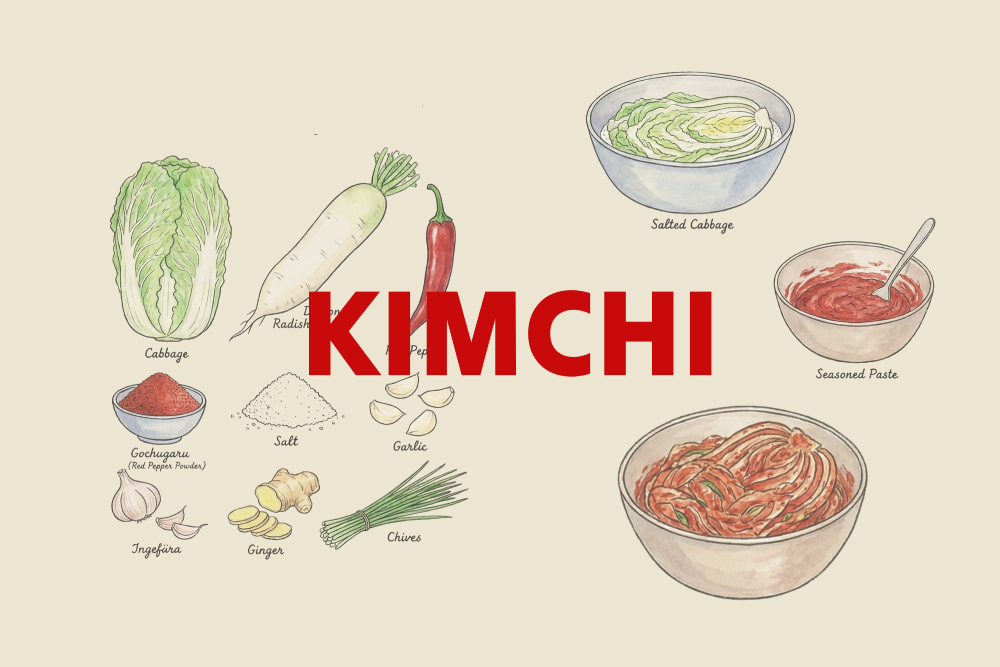
    To the untrained eye, making Kimchi might look like a simple cooking class: mixing vegetables with spicy sauce. But in Korea, when the icy wind of November hits, it signifies the start of a war.

    We call this ‘Gimjang.’ It is a massive annual event where families gather to make enough Kimchi to last the entire winter and spring. It is so culturally significant that UNESCO inscribed Gimjang as an Intangible Cultural Heritage of Humanity in 2013.

    Why? Because Gimjang isn’t just about food. It’s about community, identity, and survival. It’s about ensuring the family has enough vitamins to endure the harsh winter. And apparently, it’s also about intense manual labor that can induce childbirth (You’re welcome, Mom).

    The true journey of Gimjang begins not in the kitchen, but here: scouting for the perfect ingredients at the traditional local market.

    The Battlefield: Operation Cabbage

    My mother transforms into a four-star general during this time. Once the date is set, she moves with military precision.

    • The Mission: Secure 50+ heads of prime cabbage from the local market.
    • The Enemy: The stiff, raw cabbage that needs to be tamed.

    The process is brutal. The day before the main event, the cabbages must surrender. We soak them in salt water until they lose their stiffness and bow down to us, becoming soft and flexible.Then comes the ammunition. We blend a potent mix of red chili powder, garlic, ginger, fermented fish sauce (jeotgal), and sticky rice paste. Sliced radishes join the mix to add a crunch. When this red paste meets the salted cabbage, the magic happens. The pale vegetables turn a fiery red, ready to punch your taste buds and boost your immune system for the year.

    The Assistant’s Life (That’s Me)

    Even though I am the legendary “Kimchi-born,” my rank in the kitchen is surprisingly low. I am merely the Assistant.

    I watch my mother’s hands move faster than a machine. My job is to carry the heavy tubs, move the ingredients, and clean up the “debris” of the battle scattered across the living room floor. It is back-breaking work.

    But I don’t complain. Because I know exactly what comes next.

    The Golden Ticket: Bossam (The Real Prize)

    This is the secret reason why Koreans volunteer for this war. The moment the Kimchi is packed into jars, the real feast begins. We boil pork belly (Bossam) until it is tender and juicy.

    Imagine this: A slice of steaming hot pork, wrapped in a piece of freshly made, unfermented Kimchi, topped with a raw oyster. It is savory, spicy, crunchy, and soft all at the same time. This taste is a privilege reserved only for those who survived the Gimjang battle.

    The Sad Truth: That Jar on Your Shelf is Lying

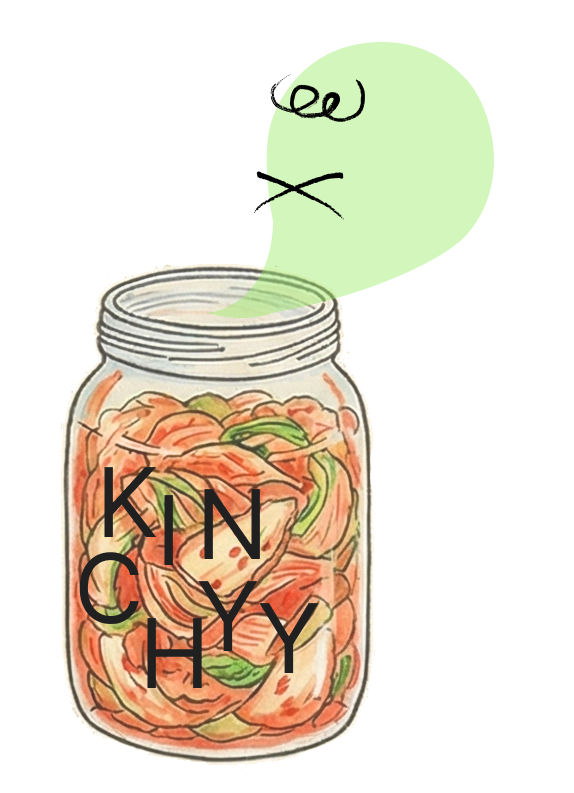
    After reading about fresh Kimchi and pork, I have a confession to make. I have seen them in supermarkets abroad. Small glass jars or tin cans, sitting on the “International Food” shelf, staring back at me with sad, pitiful eyes.

    Kinchyy sounds sketchy

    Inside, there is pale, washed-out cabbage floating in watery brine. They are labeled “Kimchi,” but to someone born on the battlefield of real Gimjang, they look like ghosts.

    Let’s get one thing straight. Simply pickling cabbage in salt and vinegar does not make it Kimchi. Those commercial jars might mimic the sour taste, but they are missing the most important ingredient: The Process.

    They lack the “Battle.” They lack the frantic energy of November. They lack the interaction between the red chili powder and the salted cabbage that creates a deep, fiery fermentation.

    Most importantly, they cannot bottle the Devotion. Real Kimchi contains the sweat of the family, the cold air of winter, and the touch of a mother’s hand (literally, we call it Son-mat, or ‘hand-taste’). When you open a can of mass-produced, pale cabbage, you are just eating a vegetable. But when you eat Kimchi from a Korean home, you are consuming Time and Soul.

    So, please. If you see those sad little jars in the supermarket, don’t judge Korean cuisine by them. They are just trying their best, but they never stood a chance against the real thing.

    The Spoils of War: A Mother’s Love

    The battle ends, but the supply lines remain open. Even as her joints ache and her muscles scream from the labor, my mother—the Commander—never stops until every container is full. She pushes her physical limits not for herself, but to pack heavy bundles of Kimchi for her grown children.

    When I drive away from her house with a trunk full of these heavy boxes, I feel a strange sense of security. It’s not just food; it is reassurance. No matter what happens in the coming year, I have my “basic ammunition” to survive.

    The Shape-Shifter: From Fresh to Aged The magic of this “loot” is that it is alive.

    • Day 1 (Haet-Kimchi): It is fresh, crunchy, and raw—perfect with pork or hot rice.
    • Month 6: It ferments and turns sour, gaining probiotics and depth.
    • Year 1+ (Mukeunji): It transforms into “Aged Kimchi.” It becomes soft and incredibly potent, destined to be reborn as a rich stew (Kimchi-jjigae) or a savory pancake (Kimchi-jeon).

    The Real Protagonist Writing this, I realized something. We often call Kimchi a “side dish” (Banchan), but that is a lie. It dictates what we eat. It saves a boring meal. It evolves with time, changing its character just like we do.

    On the Korean table, Kimchi is not a supporting actor. It is the Protagonist. And my mother, who crafts this protagonist every winter with her aching hands, is the director of this beautiful, delicious drama.

    The Taste of Time

    So, do I smell like garlic and chili powder? I hope so. It means I carry the scent of my mother’s hard work and the history of my culture.

    If you ever visit Korea, don’t just look for the finished product. Look for the process. Look for the families gathering in November. And if you are lucky enough to taste that fresh, spicy Kimchi wrapped around a piece of pork, remember: You are not just eating cabbage. You are tasting the fierce love that gets us through the winter.

    Think you have what it takes to join the battlefield? Don’t worry, you don’t need to salt 50 cabbages like my mom. Experience the fun part of the ritual (and skip the back pain) with a local expert.