Welcome to Every Three PM

Category: Personal Notes

  • In a Land of Speed, Why I Choose a 3-Minute Pause

    In a Land of Speed, Why I Choose a 3-Minute Pause

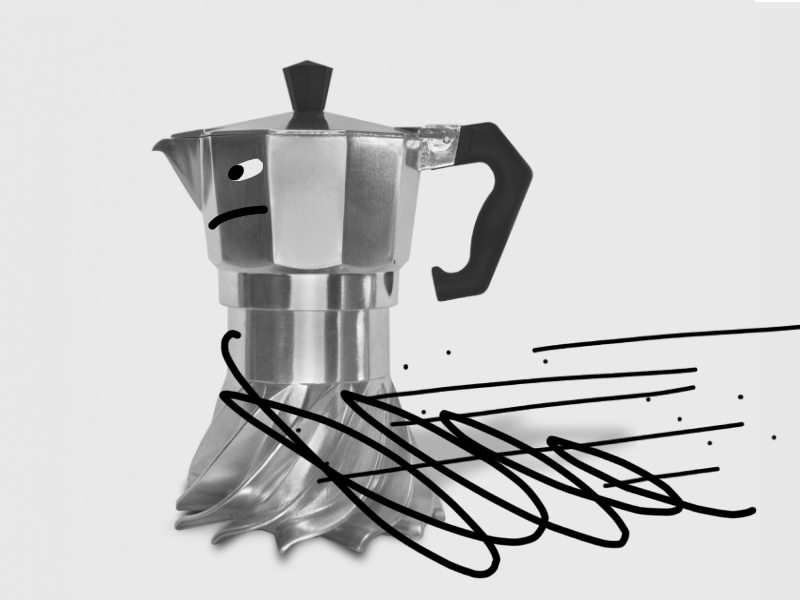
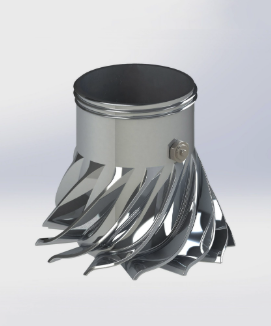
    As seen in the photo above, the Turbo Moka features a distinct ‘Helical Spiral’ base design, quite different from traditional Moka pots. This gear-like pattern is the core technology that maximizes heat efficiency and drastically reduces brewing time.

    Every morning, I reach for my old partner, the Bialetti Moka Express. Recently, a new product called the Turbo Moka caught my eye, and it made me think about how much of our lives are shaped by speed.

    A Swan on the Water

    The Turbo Moka reminds me of a graceful swan. On the surface, it keeps the familiar eight-sided silhouette first introduced in 1933. Beneath it, a turbine—almost like a jet engine—quietly works to shorten the wait.
    It’s a fascinating blend of Italian heritage and Korea’s fast-paced palli-palli spirit. Clever, efficient, and thoughtfully designed—just not quite how I like to begin my day.

    Where Speed Feels Right—and Where It Doesn’t

    Korea is one of the fastest countries in the world, and I genuinely admire that. When it comes to work, I rely on that speed. It helps me focus, decide, and move forward without hesitation.

    But coffee is different.

    In cafés and restaurants, I often find myself drawn to slower moments—the kind of unhurried atmosphere I usually experience while traveling abroad. As everything around us accelerates, these small pauses begin to feel more valuable.

    So during coffee time, I choose a different rhythm. Instead of instant coffee or 30-second capsules, I follow a more traditional European style: grinding beans, filling the chamber, waiting by the stove.

    The Value of Taking a Little Longer

    For adults, coffee is rarely just about caffeine.

    In the morning, it’s a gentle way to wake the senses.
    In the afternoon, it’s a brief chance to breathe between obligations.

    Yes, cleaning aluminum requires care, and manual brewing takes patience. But I’ve grown fond of this kind of effort. There’s a quiet satisfaction in doing something slowly, with intention—a small, personal luxury that doesn’t announce itself.

    Choosing Slowness, On Purpose

    The Turbo Moka is an impressive piece of innovation. It respects tradition while making room for speed, and for many people, that balance is exactly right.

    For me, though, slow extraction is the only low-speed zone I allow myself each day. It’s not about rejecting efficiency. It’s about choosing where speed belongs—and where it doesn’t.

    So how fast was your coffee today?
    Did it rush you, or did it wait for you? Sometimes, being slow isn’t falling behind.
    It’s simply making space for yourself.

  • The Last Jesa Table: Closing My Family’s Chapter

    The Last Jesa Table: Closing My Family’s Chapter

    The Fading Tradition

    It feels like this tradition is disappearing with my generation. My parents might be the last generation to perform ‘Jesa’ (제사), the Korean Confucian ceremony of worshipping ancestors.

    In my family, we held rites for ancestors up to my great-grandparents, so we had ‘Jesa’ several times a year. Since my father is the eldest son (Jangnam), these rituals always took place at our house.

    As a child, I simply loved those days. All my cousins would gather, we didn’t have to do homework, and we played late into the night. It was just a fun party for us kids.

    The Weight of Mother’s Labor

    But the moment I discovered my mother’s toil, those days became a burden on my heart. Aside from the meaning of honoring ancestors, for the descendants living in reality—especially the women—it was a negative experience. How can I evaluate tradition? I can’t. But I certainly have the right to evaluate my mother’s hard work. Here is why.

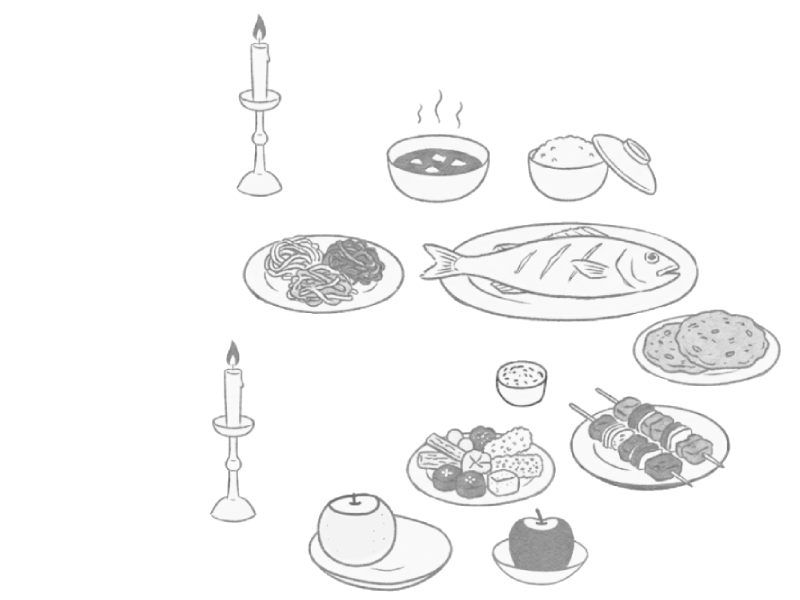
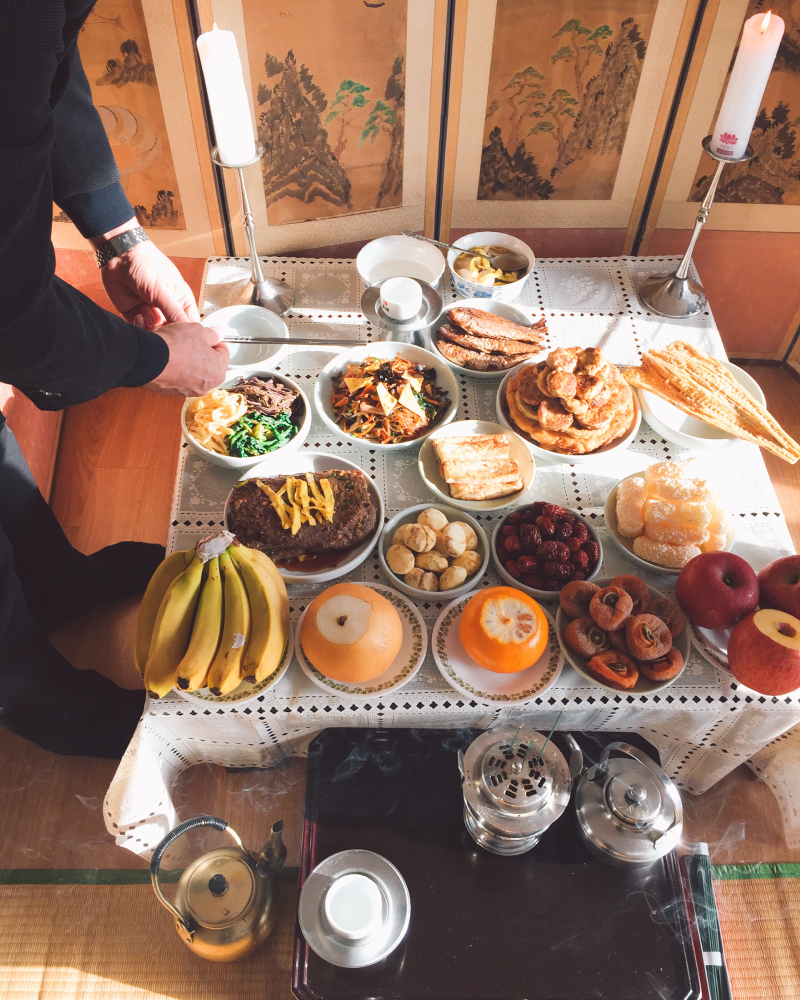
    The food preparation begins a week in advance. There are mandatory menu items that must be on the table: Beef soup, rice, dried croaker (Gulbi), skewered meat (Sanjeok), three-color seasoned vegetables (Namul), various pancakes (Jeon), and Bindaetteok. Sometimes, we added special foods the ancestors preferred when they were alive.

    My mother never did anything carelessly. She trimmed, cooked, and prepared everything with her whole heart, which required an immense amount of time and effort. On top of that, during major holidays like Seollal(Lunar New Year) and Chuseok, the same table setting and rituals (called Charye) were required.

    The table was recently reduced to half its size, but every dish still demands time, care, and devotion.

    The Ritual: Hunger and Strict Rules

    Jesa was always held at night. We had to skip dinner before the ritual, so we started the ceremony clutching our hungry stomachs.

    The table setting begins with reverence and caution. Food is placed on a low, wide table according to strict rules like “Hong-Dong-Baek-Seo” (Red foods on the East, White on the West) and “Eo-Dong-Yuk-Seo” (Fish on the East, Meat on the West). The tops of the fruits are cut off to make it easier for the ancestors to eat. We light incense and candles to signal our location to the spirits.

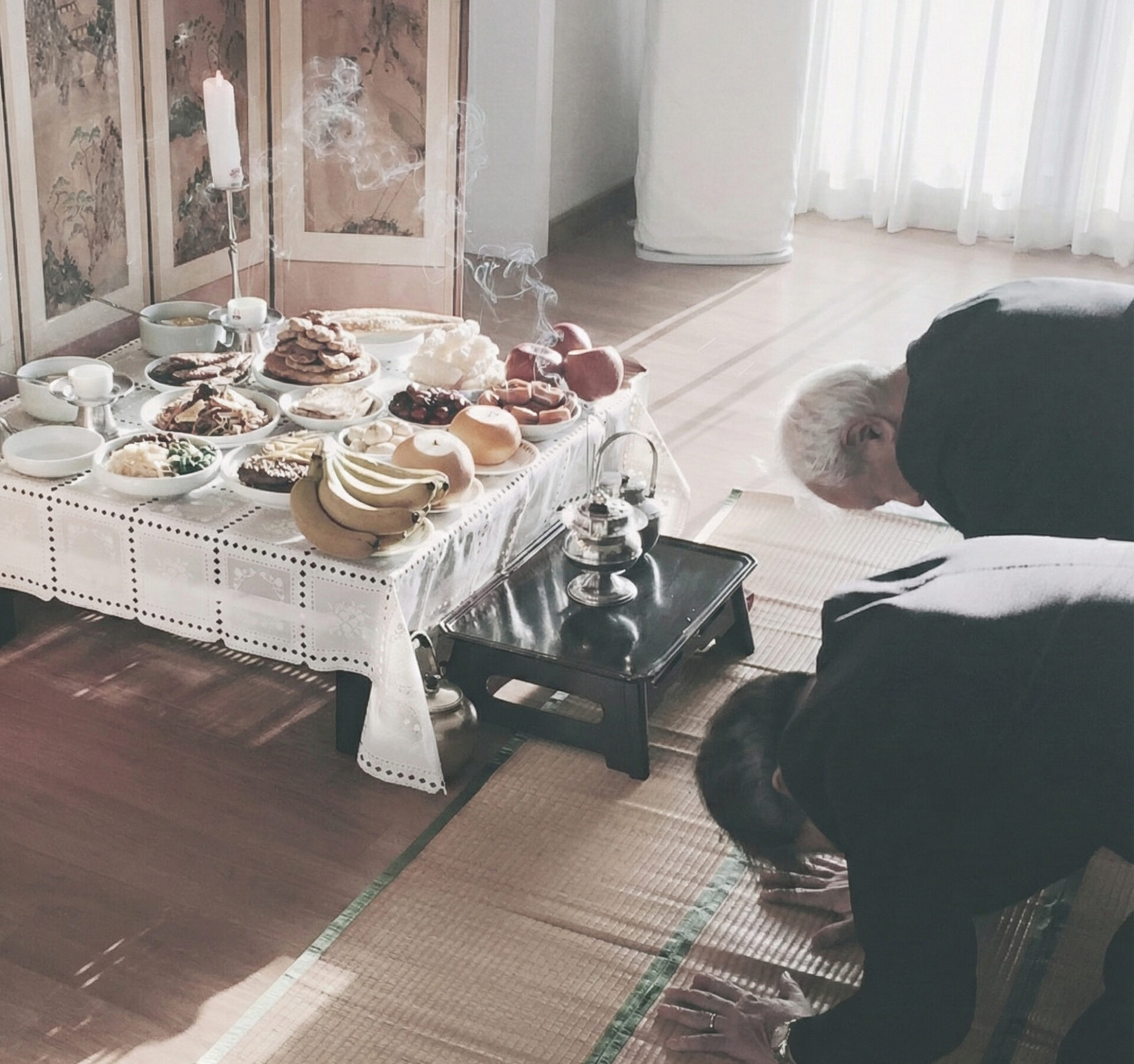
    Once the table is set, the ceremony begins. We rotate the alcohol cup over the incense smoke and place it near the rice bowl. It’s as if the deceased ancestors are sitting right there. We treat them with the utmost politeness using two hands. Then, the men stand in a line facing the table and bow. Not once, but twice.

    Amidst rising wisps of incense smoke in a reverence-filled space, offering a deeply devoted bow in honor of ancestors.

    The Aftermath: Blessings and Dirty Dishes

    When my father, the eldest son, finally says, “It’s over,” it becomes dining time for the descendants. The food offered on the ritual table becomes our late dinner. The ceremony always ended late at night.

    And then, the reality hits. Did we truly accumulate ancestral blessings as high as that stack of dirty dishes?

    On holidays like Seollal, this ceremony happens in the morning. The ancestors eat first, and then the descendants eat.

    My Own Way of Remembering

    To be honest, holding rites for ancestors I had never even met didn’t really touch my heart.

    With the rise of nuclear families and growing individualism, the rigid and burdensome formalities of these rituals are naturally fading away. While the situation varies from family to family, the tradition of strict ancestral rites is gradually disappearing.

    Even if these traditions eventually disappear, I would still set the table with all my sincerity whenever I want to remember my loved ones. It would be a personal ritual featuring their favorite foods—a quiet, meaningful way to meet them again with my heart.

  • Just a ‘Dog Dream’? Why Tigers Rule the Korean Dream World

    Just a ‘Dog Dream’? Why Tigers Rule the Korean Dream World

    Yesterday, I had the weirdest dream.

    I was walking in my neighborhood, and I met the usual stray dogs. But something was different. They were all wearing sleek, high-tech AI translators around their necks. And they were talking to me—complaining about the weather and asking for snacks in perfect human language. If I told this to a Western friend, they would laugh and say, “Lay off the sci-fi movies before bed.” But as a Korean, I hesitated for a split second: “Wait… is this a sign?”

    The President and the Ginkgo Tree

    Why do I hesitate? Because in my life, I have experienced a dream that actually came true.

    Years ago, I dreamed I was standing under a beautiful, golden Ginkgo tree. Next to me was someone who was running for President at the time. Together, we were peacefully picking up ginkgo nuts from the ground.

    It felt incredibly real. And guess what? They actually won the election and became the President later that year. Because of experiences like this, for Koreans, dreams aren’t just mental noise or anxiety processing. They are often treated as unread text messages from the future.

    Teeth vs. Tigers: The Cultural Divide

    When Westerners wake up with a strange dream, they usually consult a “Dream Dictionary” on Google to analyze their stress. Common search terms include “Teeth falling out” or “Being chased.” The focus is usually internal anxiety: “What is my subconscious telling me about my feelings?”

    In Korea, we look outward to Fate. And the most famous example of this is a unique tradition called “Taemong” (Conception Dreams).

    Jennie’s Tiger: A Prophecy of a Queen

    In the West, pregnancy dreams are often just seen as the mother’s subconscious. But in Korea, a Taemong is a destiny forecast.

    Take Jennie from BLACKPINK. Before she was born, her mother didn’t dream of a cute little bird. She dreamed of a massive tiger. It wasn’t scary; it was majestic and dignified, with sparkling, intense eyes.

    In Korean interpretation, a tiger symbolizes a person of great influence and charisma. Looking at Jennie now—dominating global stages with her fierce aura—it feels less like a coincidence and more like a prophecy.

    Wait, You Can Buy and Sell Dreams?

    Here is the plot twist: The mother isn’t always the one who has the Taemong.

    In Korea, pregnancy dreams are a communal event. Often, a grandmother or a best friend wakes up and says, “I dreamed of a giant peach! I think you are pregnant.”

    This leads to a fun tradition called “Buying the Dream” (Maemong). If your friend has a lucky dream for you, you have to “buy” it (usually with a coin or a nice lunch) to make the luck yours. It’s a charming ritual that turns a subconscious experience into a shared celebration.

    So, What About My “AI Dog” Dream?

    Now, back to my talking dogs. Was it a prophecy like my President dream?

    Sadly, probably not. In Korean, we have a funny word for messy, meaningless dreams: “Gae-kkum” (개꿈). Literally translated, it means “Dog Dream.”

    So, my dream about dogs was, quite literally, a Dog Dream. Just nonsense!

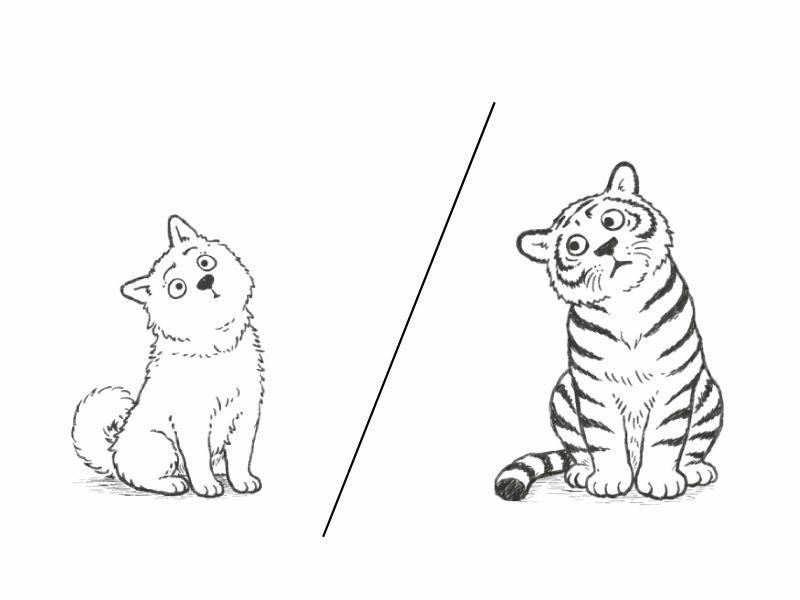
    But that’s the fun of it. We wake up wondering, “Is this a Dog Dream or a Tiger Dream?” and start our day with a little bit of mystery.

    I hope you sleep well tonight. And if you dream of a pig or a dragon, don’t forget to tell me—I might want to buy that dream from you!

  • Personal Color Analysis: Everything K-Beauty Reveals About Your ‘Skin Tone MBTI’

    Personal Color Analysis: Everything K-Beauty Reveals About Your ‘Skin Tone MBTI’

    Korean Personal Color Analysis is one of the biggest keywords in K-Beauty right now, but is it just a fleeting trend? Imagine walking into a massive K-Beauty store in Seoul. You simply want a red lipstick. But here, you face a famous K-Beauty commandment:

    “There is no such thing as the same Red under the sky.”

    It implies that literally no two shades are alike. There isn’t just “Red.” There is Chili Red, Brick Red, Cherry Red, Apple Red, and Rose Red. K-Beauty has reached the absolute peak of subtle color nuances. Without a guide, you are lost in this ocean of choices. That is why you need Personal Color Analysis. It is not just vanity; it is a “Survival Map” to navigate these millions of options!

    Why You Need Korean Personal Color Analysis: The Maze of Colors

    Because of this overwhelming variety, Koreans treat skin tone almost like a science. Just as we introduce ourselves with our MBTI (“I’m an ENFP!”), we also categorize our faces.

    • “I’m a Cool Summer Light.”
    • “I’m a Dark Winter.”

    It can almost sound like a clinical diagnosis—but in Korea, this label isn’t about restriction. It’s about self‑understanding through expert validation. With help from a professional, you receive a shared language to describe your natural features. That single result becomes a reference point you can apply across makeup, fashion, hair color, and accessories. It saves time, reduces guesswork, and helps you make consistent choices without starting from zero every time.

    Western vs. Korean Personal Color: Adding vs. Subtracting

    If you are from a Western background, you might find the Korean approach quite different. This creates a fascinating cultural clash:

    I read a review from a Western traveler who tried Personal Color Analysis in Seoul. When the expert held up a specific color swatch, she praised it saying, “Your face looks so bright and clear!” However, the traveler felt differently. She simply remarked, “But I look like a sick vampire.”

    This reaction perfectly sums up the difference:

    • The Western Way (Adding): Beauty is often about “More.” You add bronzer to look sun-kissed, healthy, and rich. If you like a color, you wear it. It is about Expression.
    • The Korean Way (Filtering): Beauty is often about ‘Filtering’ or ‘Subtracting.” We want to remove yellowness, redness, and dark circles. We want our face to look like a clean, blank canvas. It is about Optimization.

    Basically, Western makeup is like Painting, while Korean makeup is like Photoshop Editing.

    I’m a Warm Spring.

    Finding My True Colors: A Journey of “Wrong” Choices

    However, knowing these strict rules shouldn’t turn into a restriction. I’m a ‘Warm Spring,’ and while I love my peachy tones, I refuse to be a slave to the data. I remember wearing a bold Purple Lipstick in college. It wasn’t about being rebellious; it was part of a journey of countless attempts to find myself.

    If I had known the strict rules of Personal Color back then, I might have hesitated to pick up that lipstick. But because I didn’t know, I was free to explore. That process of trial and error helped me discover my true colors—whether it’s a physical shade, my inner character, or my personal taste. All those experiences served as nourishment for my growth. So, let’s not box ourselves in with MBTI or color charts. True beauty comes from the freedom to explore beyond the boundaries.

    PANTONE Limited Edition SkinTone Guide

    The global standard featuring 138 real skin tones: The Pantone SkinTone Guide (STG203)

  • From Window Shopping to Art Hopping: How Seoul Turned Retail into a Gallery Experience

    From Window Shopping to Art Hopping: How Seoul Turned Retail into a Gallery Experience

    Meeting the Wizards of Display

    Before discussing the dynamic evolution of Seoul spatial branding, I must talk about where my inspiration began: London. When I first landed there, about 80% of the awe I felt came purely from its “exhibition spaces.” It felt as if every display guru on the planet had held a summit right there to define the future of retail.

    From galleries and museums to street-side shops, the way they interpreted space visually was different. It didn’t just “show” things; it whispered to you in a sophisticated, visual language.

    A theatrical window display at Selfridges, London. Where products become part of a story.

    London: The Theater of the Streets

    Maybe it’s because London is a city that breathes theater and musicals. The ground-floor windows of department stores weren’t just glass cases; they were stages.

    I developed a weekly ritual of patrolling the perimeters of Selfridges and Liberty. These windows weren’t simply displaying products; they were displaying a flow of concepts. Even the tiniest prop seemed to be chattering away, telling a rich story where the product was merely a supporting actor.

    I would zoom in to see the details, then step back to take in the whole scene—a ritual necessary to fully process the visual feast.

    “A luxurious cultural life that cost zero pennies, yet filled my soul with extravagance.”

    It wasn’t shopping. It was a street-side musical, an open-air gallery available to anyone. That depth of emotion and effort I witnessed in London became a huge source of inspiration for me.

    Seoul: When Stores Become Galleries

    That thirst for spatial aesthetics I felt in Europe is now being quenched in Seoul.

    Starting in trend-setting districts like Dosan Park, Seongsu-dong, and Hannam-dong, the shift has been undeniable. You know Korea—once we start something, we have a tendency to go from 0 to 100 in seconds. The change is fast, positive, and absolute.

    Walking into Seoul’s hottest shops lately feels less like a retail trip and more like a visit to a modern art museum. We’ve moved away from the old formula of “cramming in as many products as possible.” The “Show Window” is dead; long live the immersive “Show Room.” This dramatic shift is what currently defines Seoul spatial branding.

    The Gentle Monster Paradox

    Nuflaat leather gloves in a dish, a high-heel shaped dessert plate, and Tamburins PUPPY perfume line packaging.

    In this shifting landscape, the strategy of Gentle Monster offers a brilliant case study.

    Unlike fashion brands that flood the market with new SKUs every season, Gentle Monster sticks surprisingly close to their steady sellers. Instead of focusing on quantity, they obsess over quality.

    We are living in an era of product saturation, eco-anxiety, and consumption fatigue. Gentle Monster made a clever pivot here. They reduced the clutter of products and poured that energy into “Spatial Experience.”

    Their stores feature kinetic art so bizarre it’s mesmerizing, creating an overwhelming atmosphere that transcends the product itself.

    “We aren’t just selling eyewear; we are selling the Gentle Monster universe.”

    This investment elevates the brand’s perceived value. It turns customers into fans who buy into a philosophy, not just a pair of glasses. In a world drowning in “stuff,” this might be the most sophisticated survival strategy: creating value through experience, not just consumption.

    The New Grammar of Desire

    Brands are now curating, not cluttering. They tell detailed stories with fewer objects, seeking perfect harmony with the background.

    The irony? This minimalist, artistic approach triggers a stronger desire to possess. When products are arranged like an art installation, the synergy makes a single object scream “value.”

    “I don’t just want the item; I want to buy this entire vibe.”

    My observation that started with the windows of London has now evolved into a fascination with Seoul spatial branding. It’s a trend I’m more than happy to watch unfold.