
Four Scenes That Revealed the Hidden Order of Tokyo
Railway lines, elevated highways, and buildings overlap in layers, while narrow alleys wind their way through the gaps. Tokyo is a city of extraordinary density and complexity. Yet, standing in the middle of it all, I found it surprisingly easy on the eyes. The city is complex, but never quite chaotic. Everything seems to have its place, and even the smallest details feel considered.
Looking at the city through a designer’s eyes, I began to wonder where this impression came from. I found clues in four everyday scenes: cars, the surfaces of streets, buildings, and the way people move through public spaces.
They led me to one simple thought:
When the underlying structure is consistent and well-organized, the details built upon it have room to stand out.
1. Cars: How Personal Care Shapes a City’s Image


The first thing that caught my attention was the cars. More than private passenger cars, it was the trucks and taxis that stood out. These were vehicles that spent long hours on the road every day, yet their bodies gleamed. Even commercial vans and work vehicles seemed remarkably well cared for.
Keeping a car clean is hardly unique to Japan. What struck me in Tokyo, however, was the sheer consistency of it, especially among vehicles that were constantly in use. There is also a popular belief in Japan that keeping your car clean can bring good fortune. Some people associate it with feng shui and the idea of kaiun, or inviting better luck into one’s life. Japan even has traditional shrine rituals to purify cars and pray for safe journeys. Of course, these beliefs alone cannot explain why so many vehicles look so well maintained. Company standards and professional pride must play a part, too.
Still, I couldn’t help seeing something almost ritualistic in the care people put into the vehicles they spend their working days in. It seemed less about showing off and more about looking after the space and tools they rely on every day.
What interested me even more was what happened when this personal habit was multiplied across the city. No one was washing their car simply to make Tokyo look better. Yet thousands of well-kept vehicles, taken together, gave the city a remarkably polished appearance. A city’s image is not shaped by grand plans alone. It can also emerge from small acts of care, repeated day after day by individuals.
2. Asphalt: The Visual Clarity of Contrast
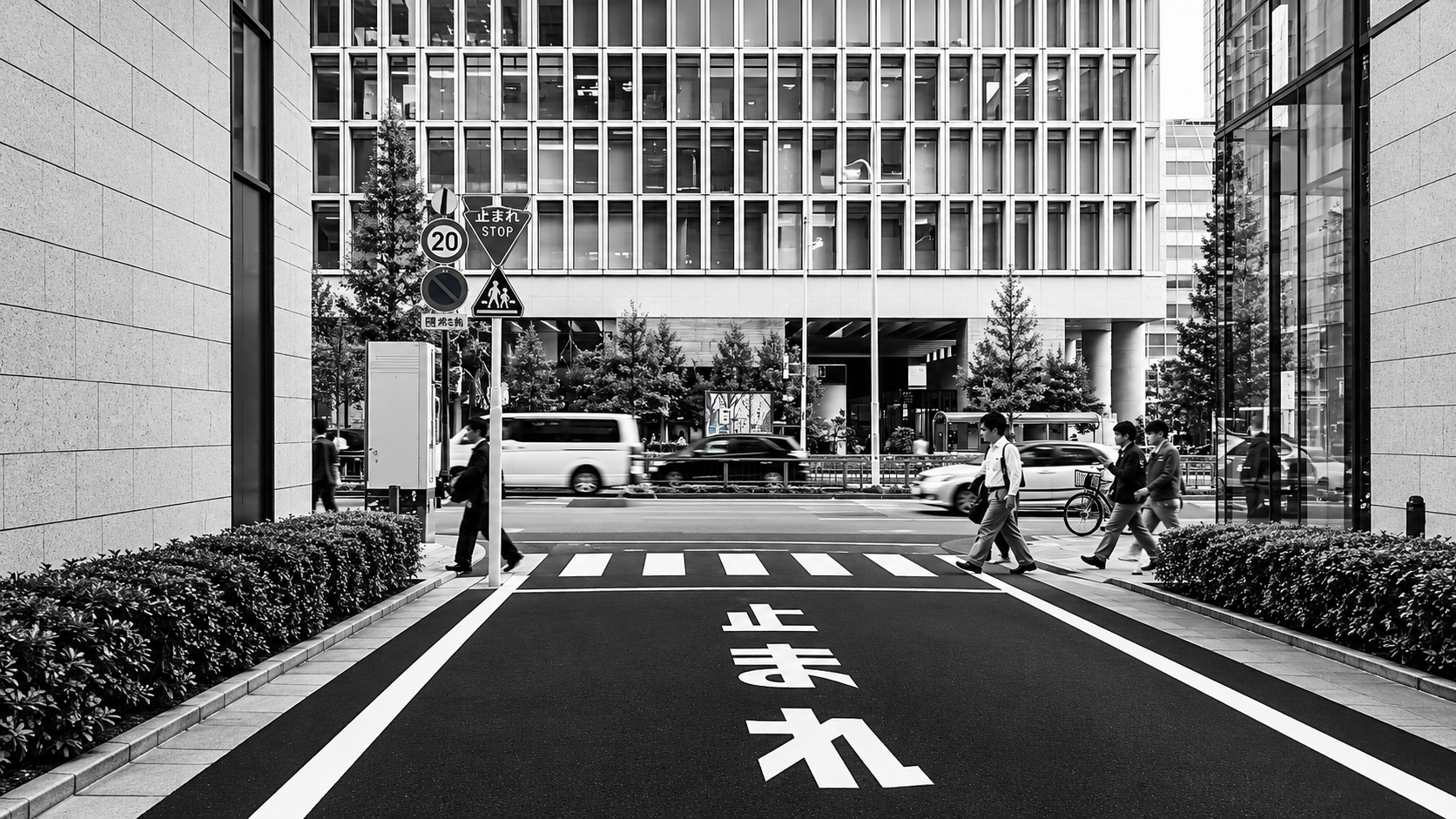
The streets offered another clue. The asphalt often appeared deep and dark, almost as if it had just been laid. Against this even, dark surface, white and yellow road markings stood out with striking clarity.
In design, contrast is one of the most basic principles of visual communication. The clearer the distinction between a background and the elements placed on it, the easier those elements are to recognize. Tokyo’s streets seemed to make good use of this simple principle. Crosswalks, lane markings, and directional symbols all stood out sharply against the dark pavement.
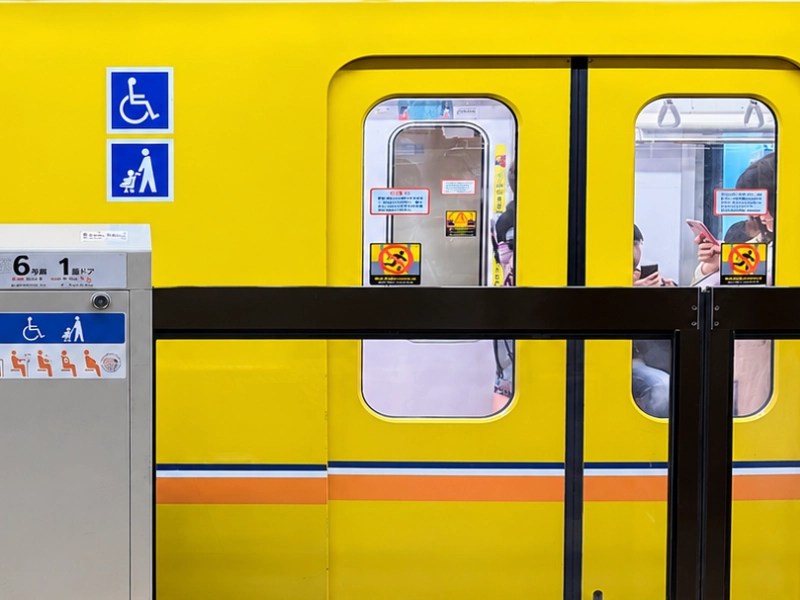
Consistent signage added another layer to this visual order. Directional signs, pictograms, and even floor markings that show where to queue seemed to follow a shared visual language. Whether I was in a different station or a different neighborhood, the way information was presented remained familiar.
Thinking in terms of design systems, it was almost as if the same set of tokens and components had been applied across the city. People don’t have to learn a new visual language every time they enter a different space. Once they understand the basic rules, they can find their way around and make sense of the information with very little effort.
It is hard to tell whether the streets look orderly because they are clean, or whether a well-maintained surface makes it easier to keep them clean. Perhaps the two reinforce each other. What is clear is that the surfaces of the city and the information placed on them work together to make everything easier to read.
3. Buildings: Simple Forms, Intricate Details


Looking up, I began to notice the same quality in Tokyo’s architecture.
Many of the city’s high-rises are built around simple geometric forms, rising in clean, straight lines. Standing close together, their vertical lines create a strong sense of direction and rhythm across the skyline. Despite the density, the repetition of these lines seems to hold the city together visually.
What I found particularly interesting was the complexity hidden within these simple forms. The overall structures are often restrained, but a closer look reveals intricate patterns in the facades, exposed structural elements, carefully joined materials, and subtle finishing details. The basic form remains simple, while the complexity is concentrated in carefully chosen places.
I was also struck by how older landmarks, such as Tokyo Station, coexist with modern high-rises. They belong to different eras and architectural styles, yet they seem to find their place naturally within the same urban landscape.
Buildings don’t have to look alike to belong together. In fact, what struck me was how different forms and architectural identities could retain their individuality while still fitting naturally into the same urban landscape.
Perhaps Tokyo’s sense of order comes not from uniformity, but from the way its diverse elements fit together without losing their individuality. It is a kind of harmony that leaves room for difference. That balance, I think, is what makes Tokyo’s dense urban landscape so compelling.
4. People: How Shared Rules Shape Collective Movement
The last scene was about people.
At Shibuya Scramble Crossing, crowds pour in from every direction the moment the lights change. Seen from above, the scene looks almost like a giant digital display. Thousands of scattered pixels begin moving at once, each finding its own place and gradually forming a new image. People cross in different directions, yet their paths seem to intersect and separate with surprising ease. Given the sheer number of people, there is remarkably little sense of chaos.
A single pixel may mean very little on its own, but when thousands of them move according to the same rules, they form a coherent picture. The white lines of the crossing, the rhythm of the traffic lights, and the designated waiting areas all help establish those rules. People don’t need to negotiate every movement with one another. A shared understanding does much of the work.
I noticed the same tendency elsewhere: people standing on one side of escalators to leave the other clear, and drivers slowing down well before reaching a red light, stopping comfortably behind the line rather than rushing through at the last moment.
A city’s complexity is not determined by the number of people or vehicles alone. The same density can create very different scenes depending on the rules that govern how everything moves.
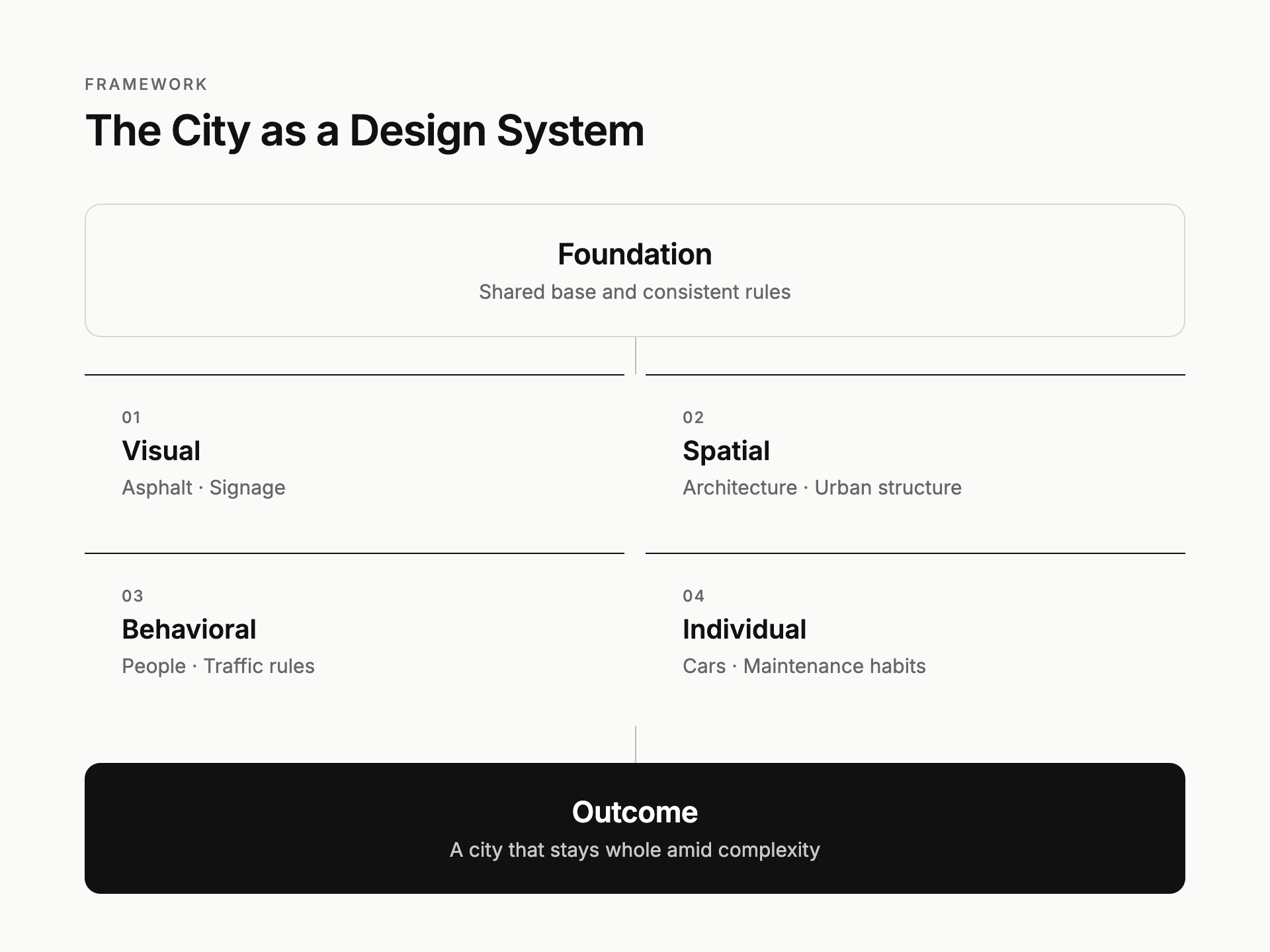
Looking back at these four scenes, they may seem unrelated at first. But together, they reveal a common pattern.
- Cars: Small acts of personal care add up to a city’s overall image.
- Asphalt: A consistent visual foundation and clear contrast make information easier to read.
- Buildings: Repeated lines and simple structures bring direction to a dense urban landscape.
- People: Shared rules turn complex movements into a coherent whole.
I began to wonder whether the remarkable finish of everyday objects in Tokyo has something to do with this, too. A door handle, a package, a shop sign: even the smallest details can feel exceptionally well thought out. This is often attributed to craftsmanship, and rightly so. Years of accumulated skill and individual dedication surely play a major role.
But as a designer, I find myself looking beyond individual skill to the environment in which that work takes place. When the basic rules and structures are already in place, people don’t have to start from scratch every time they create something. They can build on an established foundation and devote more of their time and energy to the finer details.
This is my own interpretation of what I saw in Tokyo, rather than a proven cause-and-effect relationship. Still, I wonder if there is a virtuous cycle at work: individual habits help shape the order of a city, and that order, in turn, creates an environment where individuals can do their best work.
The more complex a city becomes, the less sense it makes to simplify everything or force every element into the same mold. What matters is creating a structure in which different elements can retain their individuality and coexist harmoniously.
A single clean car was where this line of thought began. It eventually led me to a broader idea about cities and design.
Good details don’t stand on their own. They truly come into their own when the foundation beneath them is solid. And a good foundation isn’t one that makes everything look the same. It’s one that gives different things the room to express their own character and value.
For a different take on this, see
[What’s behind Japan’s curious love of cleanliness?] ➔ ➔